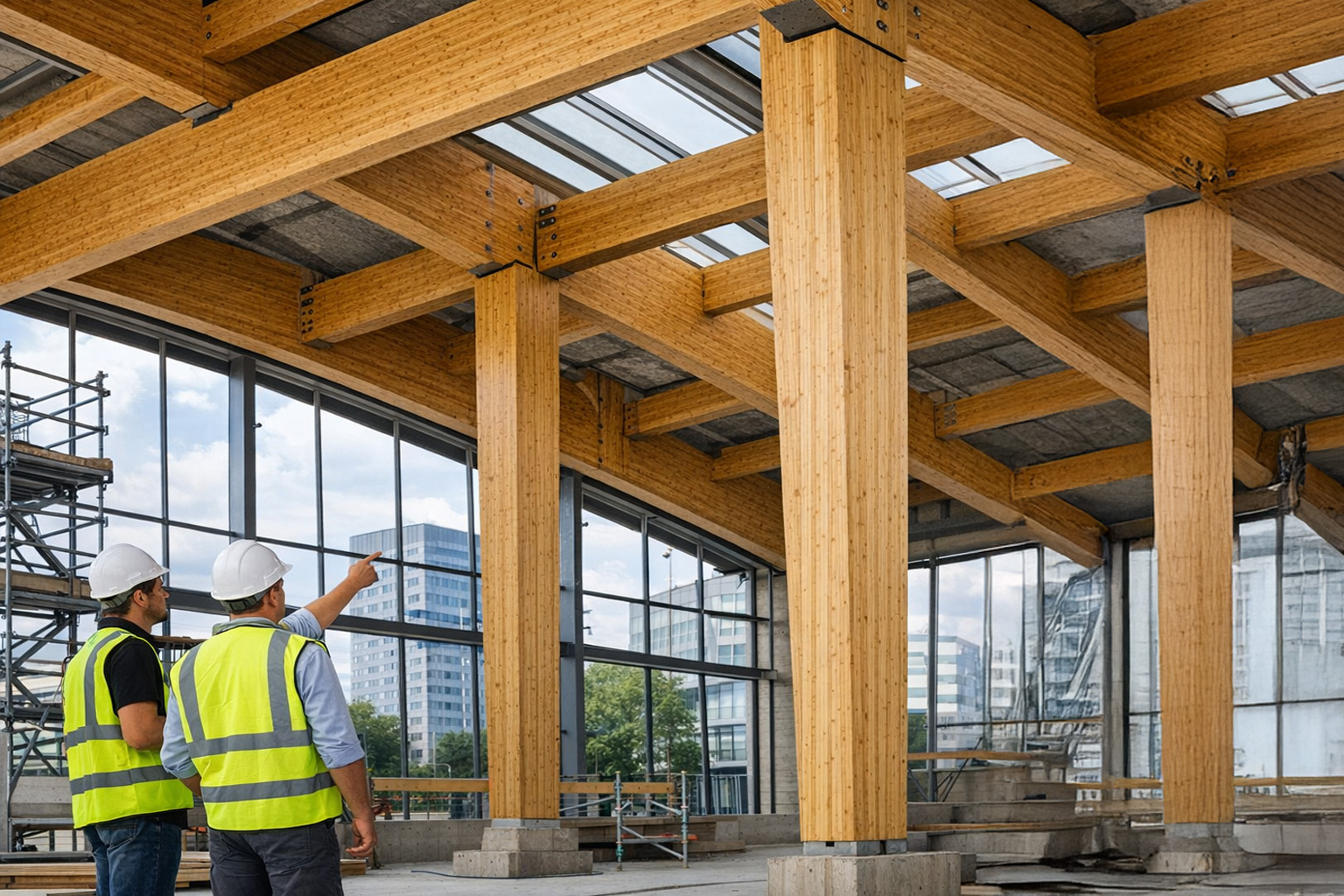
Laminated bamboo is rapidly evolving from a niche solution into a fully-fledged building material within the professional construction sector. Where bamboo was long used primarily in interior finishing projects, the focus is now shifting clearly toward structural and semi-structural applications. This development is driven by stricter sustainability requirements, raw material scarcity, and a changing market demand.
International market reports show that the laminated bamboo construction market is growing annually at a compound annual growth rate (CAGR) of 8 to 12 percent. Interest is increasing particularly in Europe and North America not only among designers and contractors, but also among wholesalers and importers of building materials.
Why Laminated Bamboo is Gaining Ground in Construction
From Niche Product to Fully-Fledged Building Material
The breakthrough of laminated bamboo is closely linked to technological advancement. By industrially laminating bamboo, products are created with consistent mechanical properties, high dimensional stability, and predictable performance. As a result, bamboo is no longer seen as a supplementary material, but as a serious alternative to wood and, in specific applications, even to steel or concrete.
For construction professionals, this means laminated bamboo is increasingly being incorporated into the design and calculation process. For wholesalers and importers, a new product segment is emerging that aligns with the growing demand for sustainable, biobased building materials.
Market Developments and Growth: CAGR of 8–12 Percent
The projected market growth of 8–12 percent per year is fueled by several factors. Governments and clients are imposing stricter requirements on CO₂ reduction and material use, while traditional building materials face price volatility and supply uncertainty.
Laminated bamboo benefits from these developments due to its rapid renewability and suitability for industrial processing. For parties active in the wholesale of sustainable bamboo building materials, this growth offers opportunities to future-proof their product range and position themselves as a knowledge partner in an increasingly professional market.
What Are Laminated Bamboo Building Materials?
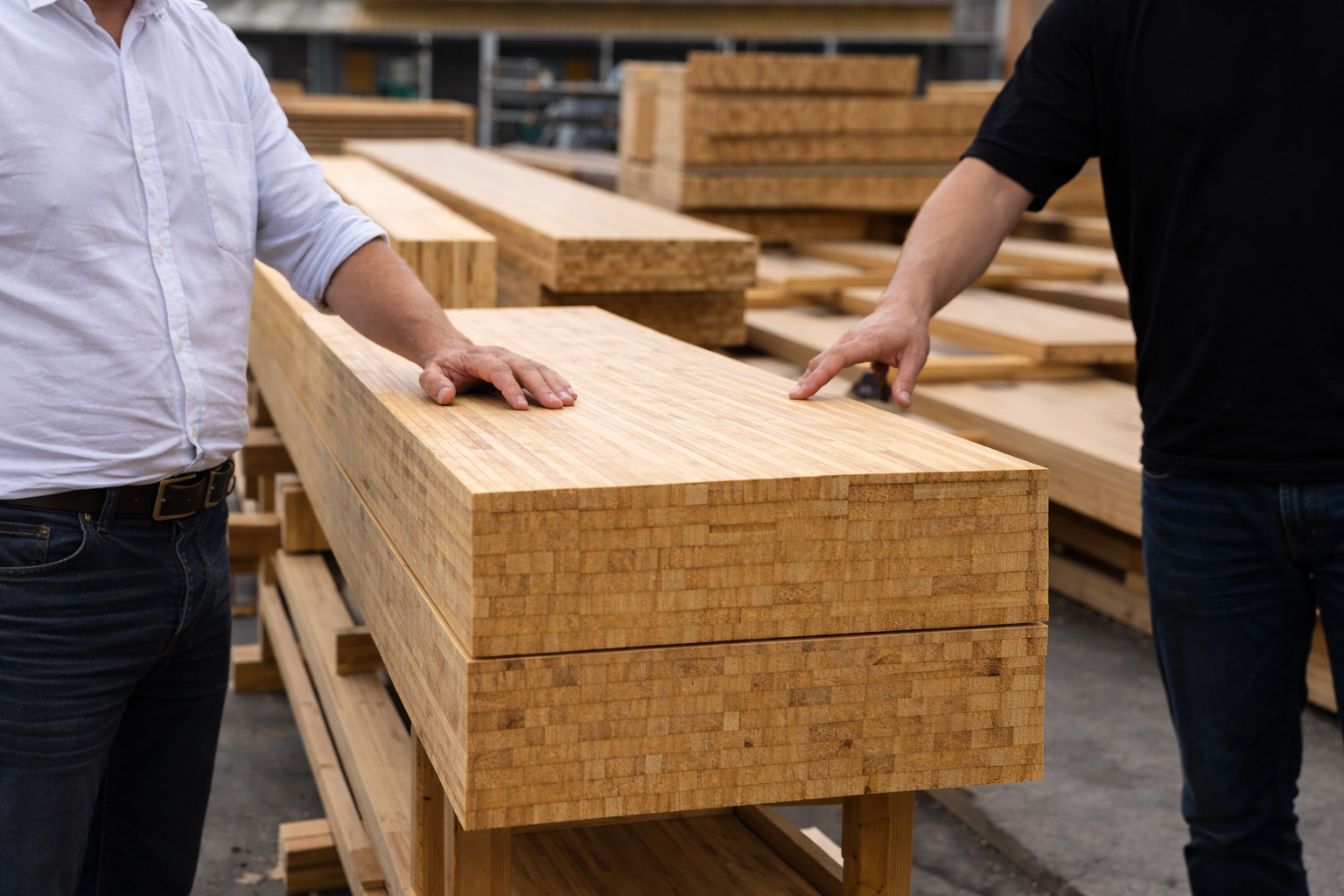
Laminated bamboo building material is an industrially manufactured product in which bamboo strips are bonded together under controlled conditions to form boards, beams, or panels. The lamination process produces a homogeneous and stable product with predictable mechanical properties, suitable for both structural and non-structural applications.
Unlike solid materials, laminated bamboo offers a high degree of control over strength, dimensional stability, and sizing. This makes it attractive for large-scale construction projects and professional building systems.
Production Process and Technical Composition
The production process begins with splitting bamboo culms into strips. These are dried, treated, and bonded together in multiple layers. By strategically positioning the layers, a product is created with optimal strength properties and minimal movement.
This controlled process makes it possible to supply high-quality, consistent bamboo panels for a wide range of applications. For wholesalers and importers, this is essential: scalability and supply reliability are only achievable when production is industrially organized and transparent.
Difference Between Solid Bamboo and Laminated Bamboo
Solid bamboo is strong, but exhibits natural variation in shape and properties. Laminated bamboo combines this natural strength with the advantages of industrial processing. This results in fewer risks during processing and application, and better alignment with quality standards and certification pathways.
Sustainable Bamboo Building Material as a Response to Market Demands
The growing interest in laminated bamboo is a direct response to changing market requirements. Sustainability has shifted from an ambition to a hard prerequisite. Material choices are increasingly evaluated on origin, environmental impact, and long-term viability.
Sustainable Bamboo Building Material as a Response to Market Demands
The growing interest in laminated bamboo is a direct response to changing market requirements. Sustainability has shifted from an ambition to a hard prerequisite. Material choices are increasingly evaluated on origin, environmental impact, and long-term viability.
Sustainability, Circularity, and CO₂ Reduction
Bamboo grows considerably faster than traditional timber species and can be harvested within a few years without replanting. In laminated form, this property is combined with efficient use of raw materials and minimal waste.
For construction professionals, CO₂ reduction is an increasingly important criterion in tendering processes. Laminated bamboo scores favorably here due to its rapid growth and long-term CO₂ storage in the finished product.
Comparison with Wood, Steel, and Concrete
Compared to wood, laminated bamboo offers greater dimensional stability and predictability. Compared to steel and concrete, the material has a significantly lower environmental impact. This positions laminated bamboo as a strategically interesting alternative in a market that is scrutinizing raw material use and supply chain responsibility.
Applications of Laminated Bamboo in the Construction Sector
Structural Applications and Prefab Solutions
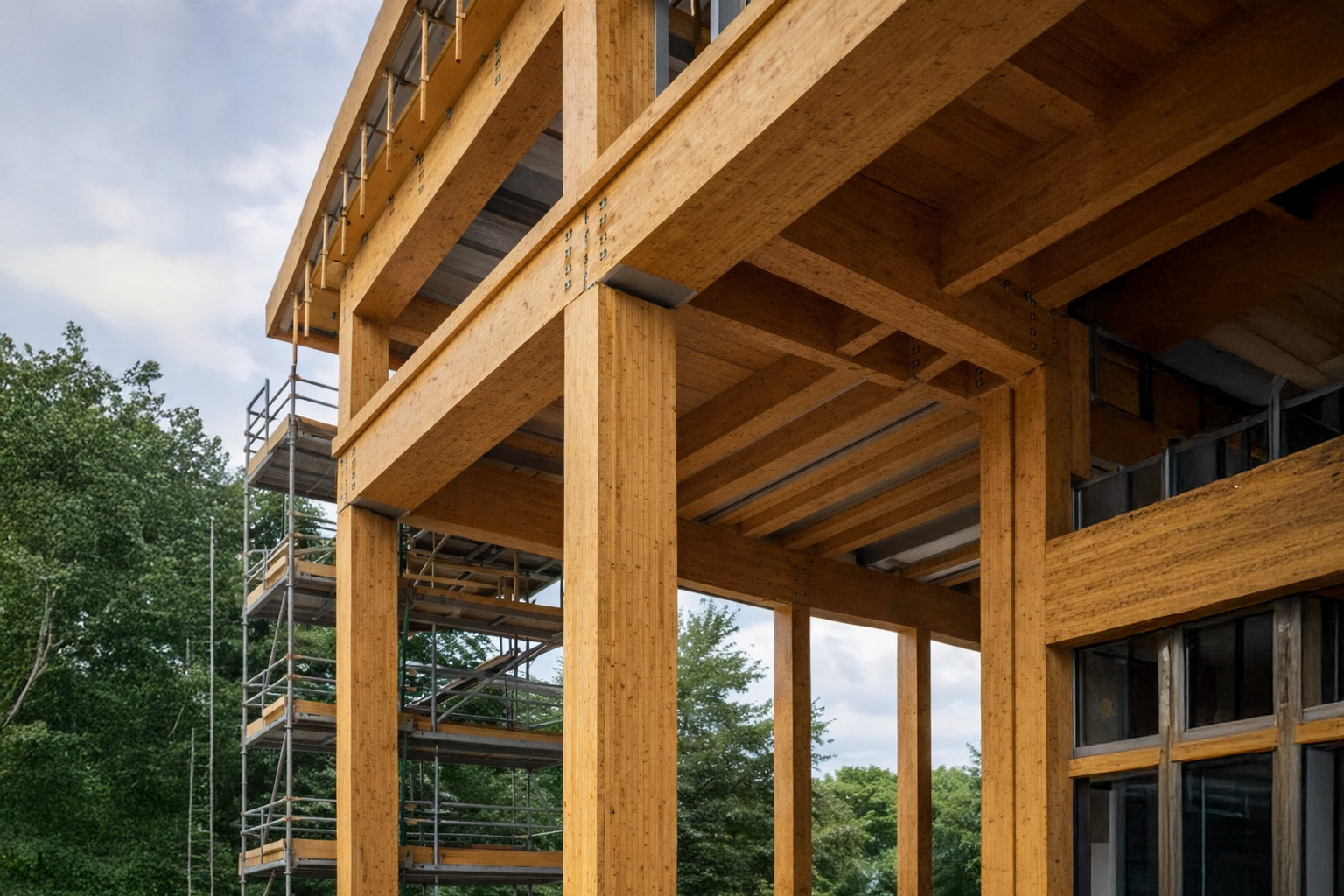
Laminated bamboo construction is increasingly being used for beams, girders, and prefabricated elements. Thanks to its predictable properties, the material integrates well into industrial construction processes.
Non-Structural Applications and Interior Finishing
Laminated bamboo also plays an important role in wall, ceiling, and interior applications. Within the range of bamboo panels, the material offers a versatile solution for both exposed finishes and functional interior work.
The Role of Wholesalers and Importers in the Bamboo Supply Chain
Scalability, Quality, and Certification
The performance of laminated bamboo is determined by selection, drying, bonding, and pressing. Only with a controlled production process is consistent quality and reliable delivery possible.
Transparency in Origin and Processing
Transparency is no longer an added bonus it is a requirement. Clear traceability of origin and transparent processing form the basis for long-term partnerships and scalable growth.
Conclusion: Laminated Bamboo as a Growth Market for the Construction Sector
Laminated bamboo is evolving from an innovative niche into a structural building material. With market growth of 8–12 percent per year, the material responds to sustainability demands, raw material scarcity, and the need for predictable construction solutions.
For construction professionals, laminated bamboo construction offers a future-proof alternative. For wholesalers and importers, there is a clear opportunity to strategically position sustainable bamboo building materials within a growing market.
For questions about applications, collaboration, or delivery, contacting us via Bamdura’s contact page is a logical next step.